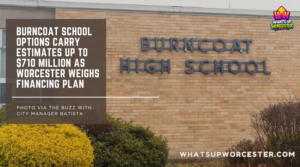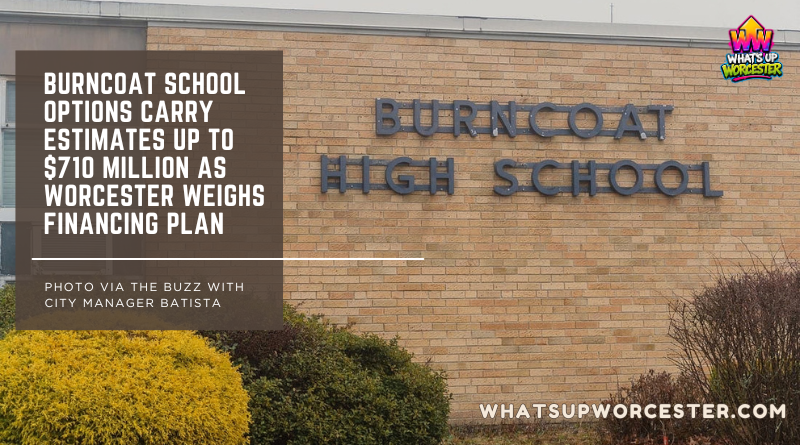

WORCESTER, MA — A new building for Burncoat High and Middle schools could cost between $635 million and $640 million, according to a city report that asks Worcester to begin preparing for debt payments years before students would enter the school.
Renovating and expanding both schools could cost even more: $685 million to $710 million.
Those estimates are part of a September 29 report submitted to City Council outlining the choices facing Worcester, along with a proposed financing approach that could draw on additional property-tax revenue beginning in fiscal year 2028.
Chief of Public Facilities James Bedard warns in the report that failing to prepare for a project of this size could lead to future budget cuts or double-digit tax increases. City Manager Eric Batista raises the same concern in his accompanying letter.
The documents present estimates and recommendations while the project remains in a feasibility study. They do not establish a final construction price, state funding award or approved tax increase.
For families, the project concerns the schools their children will attend. For the broader city, the financial question reaches into the same annual budget that supports education, public safety, public works and other services.
What Worcester is considering
Burncoat High School was built in 1964 and occupies approximately 144,000 square feet on a 39-acre site shared with Burncoat Middle School, according to the project update.
The Massachusetts School Building Authority’s invitation allows Worcester to explore a high school serving 1,400 students in grades 9 through 12, or a combined middle and high school serving 2,125 students in grades 7 through 12.
The city’s preliminary estimates compare three construction approaches for each enrollment option:
| Approach | High school only | High school and middle school |
|---|---|---|
| Basic repairs | $150 million–$165 million | $250 million–$270 million |
| Addition and renovation | $455 million–$500 million | $685 million–$710 million |
| New construction | $435 million–$460 million | $635 million–$640 million |
The basic repair approach would bring existing facilities into compliance with current building codes and Americans with Disabilities Act requirements without adding square footage. The addition-and-renovation approach would also expand the building. New construction would provide a completely new building.
These options involve different scopes of work. The lowest estimate should not be read as the price for delivering the same school as the higher-cost alternatives.
The project team is developing a Preliminary Design Program that identifies educational, space and design needs. A preferred option would follow through additional planning and review.
The financial model uses the highest estimate
Bedard’s report illustrates the potential debt burden using a $710 million project involving both schools, the upper end of the addition-and-renovation estimate.
It assumes the MSBA contributes approximately 50% of the total project cost. That is a planning assumption, not a confirmed state commitment.
Under the scenario presented, the city’s annual debt payments would rise to approximately $28 million in fiscal year 2032 and $29.6 million in fiscal year 2033. The report estimates approximately $200 million in interest over three decades, in addition to repayment of the amount borrowed.
The report puts Worcester’s outstanding debt at $981.8 million as of June 30, 2026. Bedard says renovating or replacing both Burncoat schools, even with the assumed state contribution, would substantially increase that debt and the annual cost of paying it back.
Those payments would compete with operating expenses and other capital needs, the report says. It specifically identifies police and fire facilities, Worcester East Middle School, and street and sidewalk improvements among the city’s other demands.
A proposal to start setting money aside
Bedard proposes preparing a New High School Fund before the largest payments arrive.
The first potential contribution would be up to $7.5 million in free cash. The report says that recommendation depends on confirmation of additional one-time revenue by the Massachusetts Department of Revenue.
Bedard also calls for committing $15 million of Worcester’s unused tax levy capacity to the fund beginning in fiscal year 2028.
That proposal raises a practical question for taxpayers: how much more would property owners pay, and when? The report does not translate the proposed use of levy capacity into an estimated change in a typical residential tax bill.
Its illustrative funding schedule calls for $15 million in annual contributions in fiscal years 2028 through 2030, followed by larger contributions in later years. The schedule reaches $30 million annually in fiscal years 2035 and 2036 before declining.
These contributions would help build and maintain a fund to cover the project’s debt payments. The report presents the schedule as one possible structure and says no council vote is required on the informational submission at this stage.
What residents still need to know
The cost comparison provides a starting point, but it does not answer every financing question.
The debt-service illustration uses the $710 million scenario rather than separately modeling every option. The report also does not specify whether its warning about double-digit tax increases refers to the total property-tax levy, a typical homeowner’s bill or another measure, or precisely when such an increase might occur.
What’s Up Worcester has sent Bedard questions about those distinctions, the borrowing assumptions, the expected state contribution and the revenue needed to support the proposed fund. The newsroom also requested the underlying financing spreadsheet and any available option-by-option estimates of Worcester’s share and taxpayer impact.
Those details will help residents distinguish the cost of constructing a school from the local cost of financing it over time.
What happens next
Worcester submitted its statement of interest for Burncoat in June 2021. The MSBA invited the city into its eligibility period in December 2023. The project is now in the feasibility-study phase, the third of nine modules in the state process.
The report’s projected schedule calls for submitting a preferred schematic report in March 2027 and seeking MSBA approval to proceed with schematic design in April 2027. A project scope and funding agreement is anticipated in January 2028.
If the project proceeds on that schedule, construction would begin in May 2029, with teachers and students moving in during August 2032. Field and site work would continue through December 2033. These are projected milestones subject to future decisions and approvals.
The Burncoat School Building Committee is scheduled to meet Wednesday, September 30, at 6 p.m. in the Burncoat High School cafeteria, 179 Burncoat St. Its posted agenda includes an overview of preliminary options, a cost comparison, public comment and an expected vote on submitting the Preliminary Design Program to the MSBA.
The notice also provides a virtual attendance link.

🔎 W.U.W. Verification Box
- Project / Topic: Burncoat School Building Project and Worcester’s proposed approach to financing it.
- Current Status: Feasibility study. The reviewed report presents preliminary options and financial recommendations, not a final construction or funding agreement.
- Key Dates or Decisions: September 29, 2026 report submitted to City Council; September 30, 2026 School Building Committee meeting at 6 p.m., with a vote expected on the Preliminary Design Program submission.
- Estimated Cost: $150 million to $710 million across different scopes and school configurations. New construction for both schools is estimated at $635 million to $640 million.
- Timeline: Projected construction start in May 2029; student and teacher occupancy in August 2032; field and site completion in December 2033.
- Immediate Next Steps: Committee review of options and costs, public comment, and consideration of submitting the Preliminary Design Program. What’s Up Worcester has requested financial clarifications from Bedard.
- Primary Sources: September 29 City Council packet, item 8.31A, including Batista’s letter and Bedard’s report; September 30 School Building Committee agenda.
- What We Do Not Yet Know: The selected option, final project cost, confirmed MSBA contribution, final borrowing terms, household tax impact, or any council action taken after the report was issued.
About The Author