
COMMUNITY COMMENTARY
This article was submitted to What’s Up Worcester as a community perspective. The views and opinions expressed belong to the author and do not necessarily reflect the views of What’s Up Worcester or its editorial staff.
By Gleb Tsipursky, PhD
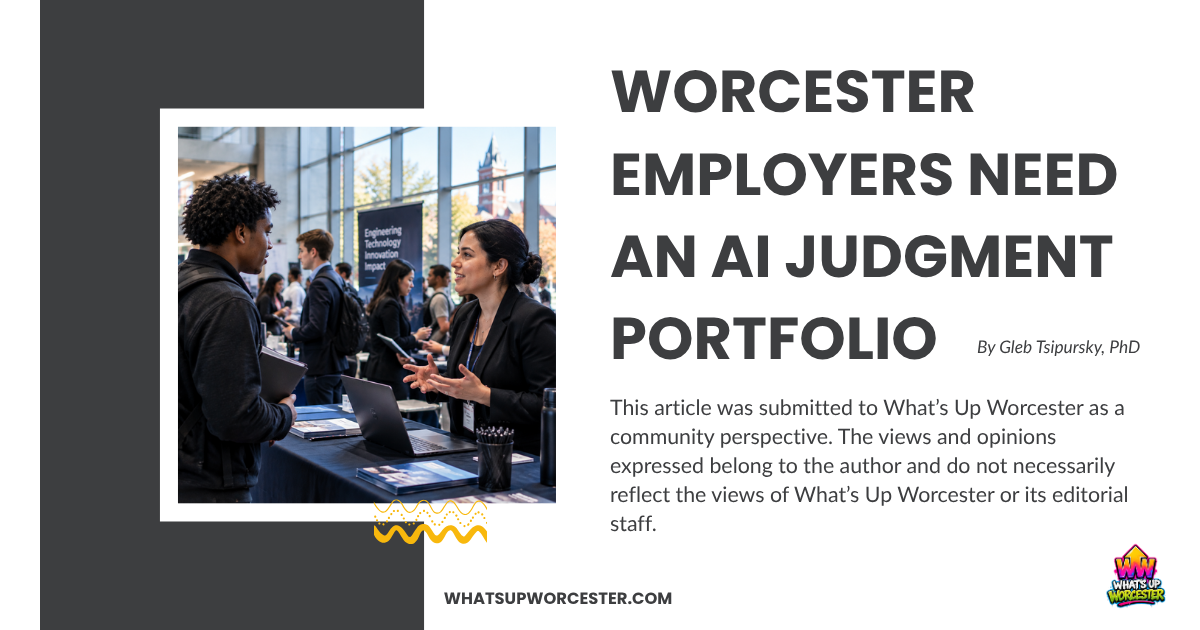
WPI’s Fall Career Fair is bringing employers and students together across two days this week. At almost the same moment, WPI staff are learning how to use Copilot for real administrative work, including document analysis and agents. Those two events belong in the same conversation.
Employers increasingly need people who can work with AI. Students increasingly know they should be able to say they can use it. But a résumé line saying “AI proficient” tells an employer very little. Prompt fluency is easy to demonstrate and hard to interpret. The more useful question is whether a candidate can improve work with AI while remaining responsible for the result.
Worcester employers can make that visible with a judgment portfolio.
Start with one short work sample completed without AI. It establishes a baseline and shows that the candidate understands the underlying task. Then ask for a comparable version completed with AI assistance. The comparison reveals whether the tool actually improves speed, clarity, analysis, or quality instead of merely changing the appearance of the work.
The third element should be verification. Ask the candidate to identify one consequential claim, calculation, recommendation, or assumption in the AI-assisted work and show how it was checked independently. Verification matters because employers do not just need people who can generate output. They need people who can decide when output deserves trust.
The fourth element is an override. Give the candidate an AI response containing a plausible but important problem and ask what should happen next. A strong candidate should be able to explain the flaw, assess its consequences, and decide whether to revise, reject, or escalate the output.
That portfolio would also help students prepare more intelligently. Instead of trying to memorize an ever-growing catalog of AI tools, they could practice a durable sequence: understand the task, use the tool, verify the result, and keep human responsibility clear.
WPI’s AI-in-the-workplace training already emphasizes practice on real needs rather than abstract demonstrations. Worcester employers can extend the same logic into hiring. The goal should be evidence that a candidate can use AI without outsourcing judgment to it.
Career fairs are built around short conversations. A judgment portfolio gives those conversations something concrete to test. For employers competing for capable people, that is more useful than asking who has the longest list of AI tools on a résumé.
Gleb Tsipursky, PhD, a behavioral scientist, CEO of Disaster Avoidance Experts, and author of The Psychology of AI Adoption at Work: From Resistance to Results (Georgetown University Press, 2026). https://

About The Author