


By: Jerry Filmore, Editor in Chief December 26, 2025
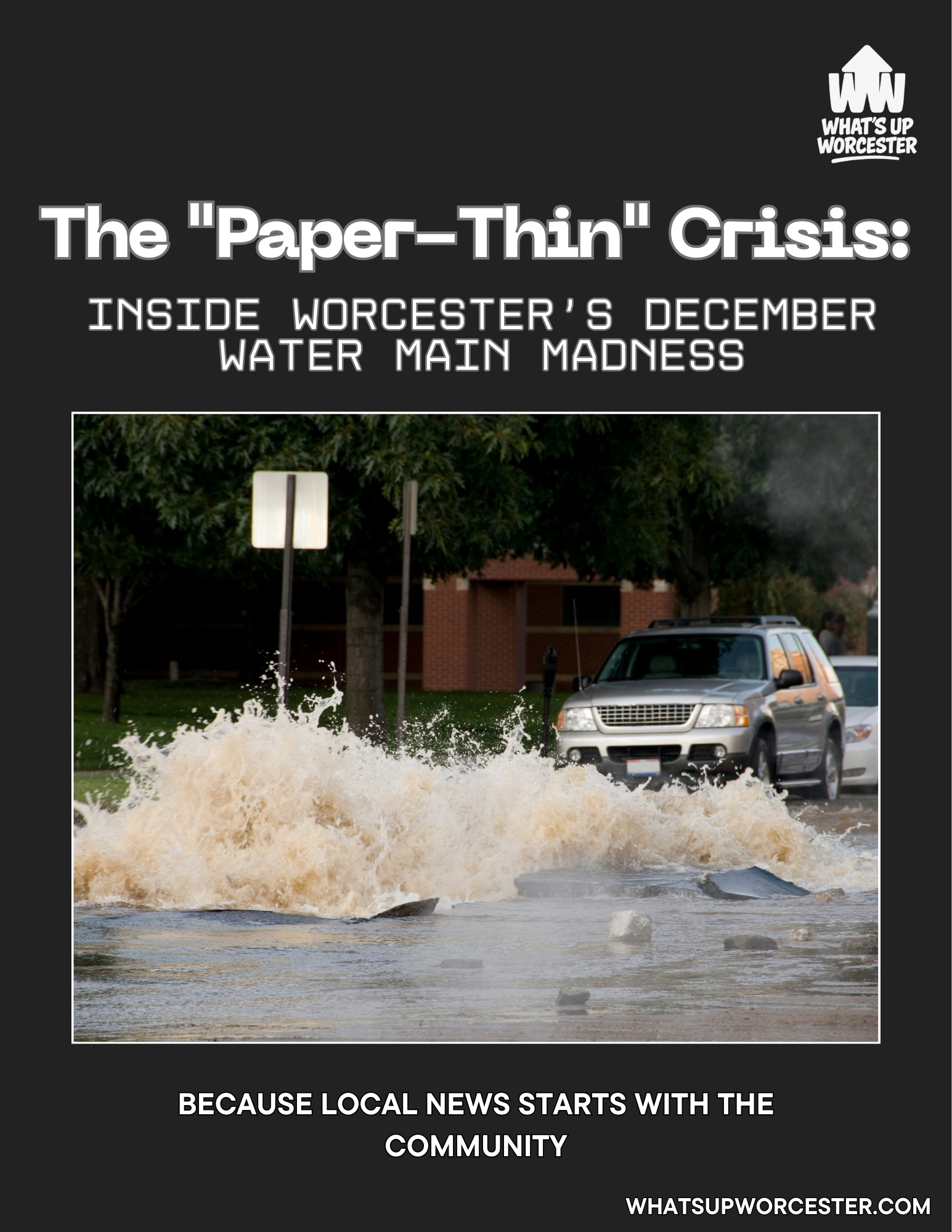
If you’ve felt like every time you turned on a faucet or drove down Shore Drive this month you were gambling with fate, you aren’t imagining it. In a staggering three-week span this December, Worcester’s Department of Public Works (DPW) has been playing a high-stakes game of “whack-a-mole” with a wave of water main breaks that has crippled city streets and triggered emergency council hearings.
At a recent City Council meeting, DPW Commissioner John Westerling didn’t just bring reports. He brought a “smoking gun.” Holding up a section of 24-inch pipe pulled from Norton Drive, he warned councilors of its fragility. The metal, originally thick and robust, had corroded until it was “as sharp as the edge of a knife.”
Here is the breakdown of what happened, why our pipes are failing, and the massive bill Worcester residents might be facing soon.
The Timeline: A Cascading Failure
The chaos was not a series of random accidents. It was a chain reaction that started in the Greendale area.
- Dec. 6: The Catalyst. A 24-inch main on Shore Drive broke early Saturday morning, causing immediate pressure drops and road closures near Norton Drive.
- Dec. 8: The “Big One.” Just as crews were finishing repairs, another massive 24-inch pipe broke on Frontage Road. This is a critical artery for the Indian Hill water tanks.
- Dec. 11 to 15: The Aftershocks. The pressure shockwaves from the Frontage Road failure triggered a sequence of breaks. This included a repeat failure on Norton Drive and a subsequent break in the Salisbury Street area.
- The Tally. While repairs are ongoing, the city has faced nearly 20 breaks this month alone. Some involved pipes dating back to the early 20th century.
Why is this happening now?
It is a perfect storm of age, chemistry, and physics.
- Corrosive Soil: The city is investigating why pipes from the 1970s are failing faster than those from the early 1900s. The leading theory is “hot” (corrosive) soil near I-290 and major on-ramps. This is potentially worsened by decades of road salt.
- The “Hammer” Effect: When a large pipe breaks, the sudden change in water velocity is known as a “water hammer.” This can snap older, brittle cast-iron pipes miles away.
- Infrastructure Debt: Many of Worcester’s pipes are over 100 years old. We are relying on Victorian-era engineering to support a 2025 population.
The “Hidden” Crisis: Your Water Bill
While the DPW works in the trenches, a different kind of flood is coming for your wallet.
Because of a long-standing legal battle with the town of Holden over sewage fees, which has now reached the State Supreme Judicial Court, Worcester residents are staring down a potential 42.9% increase in their combined water and sewer bills for FY26.
The Impact: For an average single-family home, that is a jump from roughly $689 to $984 per year. This covers a multi-million dollar judgment and rising infrastructure costs.
What is Being Done?
The city is not just digging holes. They are getting smarter.
- iHydrant Technology: The DPW is expanding the use of iHydrant sensors. These are devices attached to fire hydrants that monitor pressure and temperature in real-time. This allows crews to spot a pressure spike before it turns into a geyser.
- 311 Integration: The city is urging residents to use the Worcester 311 app to report leaks immediately. Early detection is the only way to prevent the “hammer effect” from destroying more pipes.
The Bottom Line for Residents
Expect discolored water and lower pressure as the system fully stabilizes. If you see water bubbling up from the pavement, do not wait. Call Worcester 311 or use the online portal.
Action Guide: What to Do if You Have Damage
If the recent breaks caused flooding in your basement or damaged your property, follow these steps to protect your rights and seek reimbursement.
1. Document Everything Immediately
Before you start cleaning, take high-resolution photos and videos of the standing water, the point of entry, and any damaged items like electronics, water heaters, or furniture. Do not throw anything away until an insurance adjuster or city official has seen it.
2. Mitigate Further Damage
Under Massachusetts law, property owners are expected to take “reasonable steps” to prevent more damage. Hire a professional water restoration company and keep all receipts for pumps, fans, or professional cleaning services.
3. File an Official Claim with the City
Worcester has a specific process for liability. You must file a formal claim to be considered for reimbursement.
- Download the Form: Access the official City of Worcester Claim Form.
- The Deadline: If the damage was caused by a “defect in a public way,” you have only 30 days from the incident to file. For general negligence, the window is two years, but sooner is always better.
- Submit to: City Clerk, City Hall Room 206, 455 Main Street, Worcester, MA 01608.
4. Contact Your Private Insurance
Most homeowners’ policies require immediate notification. Even if you plan to hold the city liable, your insurance company can often provide faster funds for emergency repairs and then “subrogate” (fight the city on your behalf) to get their money back.
Have a tip, story idea, or something happening in your neighborhood?
Email Editor-in-Chief Jerry Filmore at jfilmore@whatsupworcester.com or press@whatsupworcester.com — because local news starts with the community.
About The Author




Comments are closed.
Great article, thanks for the thorough explanation of what’s going on
Yo, 100 jilislot got some fire slots! Been hitting some nice wins lately. The layout’s clean, easy to find what you’re looking for. Worth checking out if you’re chasing those jackpots! Go check out 100jilislot now!