By Whats Up Worcester Staff
The new low-residency program is designed for mid-career professionals preparing for leadership roles in the growing geospatial technology field.
WORCESTER, Mass. — Clark University is launching what it says is the world’s first industry-approved professional doctorate in geospatial leadership, a new program aimed at preparing mid-career professionals for leadership roles in a rapidly growing technology field.
The new Executive Doctor of Geospatial Leadership (DGEO) program will be offered through Clark’s School of Climate, Environment, and Society and School of Business. The two-year, low-residency program is scheduled to begin in summer 2027.
The degree was announced on June 2 at Horizons 2026 in London, the flagship annual event of the World Geospatial Industry Council (WGIC).
What is Geospatial Technology?
Geospatial technology is the use of location-based data to understand people, places, systems, and change. It serves as a critical asset across various sectors and includes:
- Mapping and geographic information systems (GIS)
- Satellite data and climate modeling
- Infrastructure planning and transportation analysis
- Emergency response and public safety tracking
- Business strategy tools that optimize decision-making based on where things happen.
For Clark, the new program connects directly to areas where the university already has a strong academic focus, including climate, environment, geography, data, policy, and business leadership.
Industry Collaboration & Addressing the Workforce Gap
The program is being designed in collaboration with the WGIC. The council is working with more than 50 member organizations—including major global technology leaders—to help address a critical workforce gap in the geospatial field. Partners include:
According to Clark University, the goal is to build a stronger pipeline of executives who understand both the specialized technology and the management challenges shaping the modern industry.

Designed for Working Professionals
Unlike a traditional research doctorate, the DGEO program is built as a professional doctorate.
This format is explicitly tailored for working professionals who want to transition into higher-level leadership, strategy, and decision-making roles while continuing their careers.
The low-residency format relies heavily on asynchronous online coursework alongside brief campus visits, making the degree highly accessible to international and domestic professionals who cannot relocate full-time for graduate study.
The program targets mid-career managers and technical leaders seeking to advance in fields where location intelligence is increasingly essential, such as urban city planning, environmental conservation, infrastructure engineering, global development, and government operations.
Global Framework, Local Base
While the historic program was announced internationally in London, its home base will remain at Clark University right here in Worcester, anchoring the city in a larger global conversation about technological innovation and climate mapping.
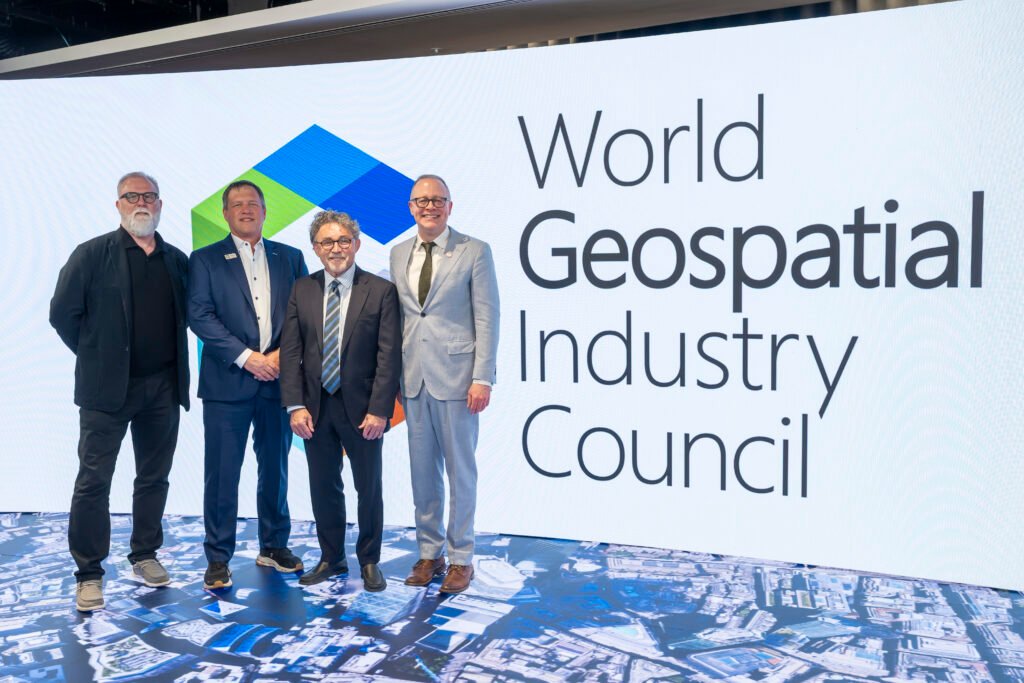
Pictured at Horizons 2026 in London for the announcement were:
- Mark Coates, vice president of infrastructure policy advancement at Bentley Systems
- Aaron Addison, executive director of the World Geospatial Industry Council
- John Wilson, founding director of the Spatial Sciences Institute at the University of Southern California
- Lou Leonard, inaugural D.J.A. Spencer Dean of Clark University’s School of Climate, Environment, and Society
Why This Matters
- Real-World Problem Solving: This is more than a new degree program. It is a sign of how critical location-based technology has become in solving massive global crises, such as modeling climate change, anticipating property risks from floods, tracking deforestation, and building climate-resilient cities.
- Worcester on the World Stage: By launching this global-first program, Clark University positions Worcester as an active hub in international tech, infrastructure, and climate leadership discussions.
- Academic Prestige: For local students and residents, the announcement serves as another reminder that Worcester’s higher education ecosystem continues to bring national and international attention to the region.
🔎 W.U.W. Verification Box
The magnifying glass represents looking closer, asking better questions, checking details, and helping residents understand local stories, resources, decisions and opportunities.
- What we verified: This article is based on information provided in an official Clark University press release shared with What’s Up Worcester.
- Key details checked: Clark University is launching the Executive Doctor of Geospatial Leadership through its School of Climate, Environment, and Society and School of Business. The two-year, low-residency program is scheduled to begin in summer 2027 and was officially announced June 2 at Horizons 2026 in London.
- Community impact: The program connects Worcester directly to a growing global tech market involving mapping, environmental metrics, corporate logistics, public safety, and executive leadership.
- Photo credit: Photo courtesy of Clark University.
- Source: Clark University Official Press Release, June 2, 2026

About The Author