

Medieval Arsenal of Interactive Fun at WAM Poised to Delight and Inspire Worcester

The Higgins Arts and Armor Collection Rises from the Dungeons in a Reimagined Cuturally Diverse Way That Resonates with Worcester.
Worcester Art Museum– Armor is sensitive, strong beautiful and resilient, just like the people of Worcester. It is prone to rust and requires great care to conserve and preserve for hundreds of years. And yet, it has lasted as art, as evidence of technological advances before the colonization of America, as a testament to human strength and innovation. It is SO Worcester!
The Nuts and Bolts of WAM’s Modernization
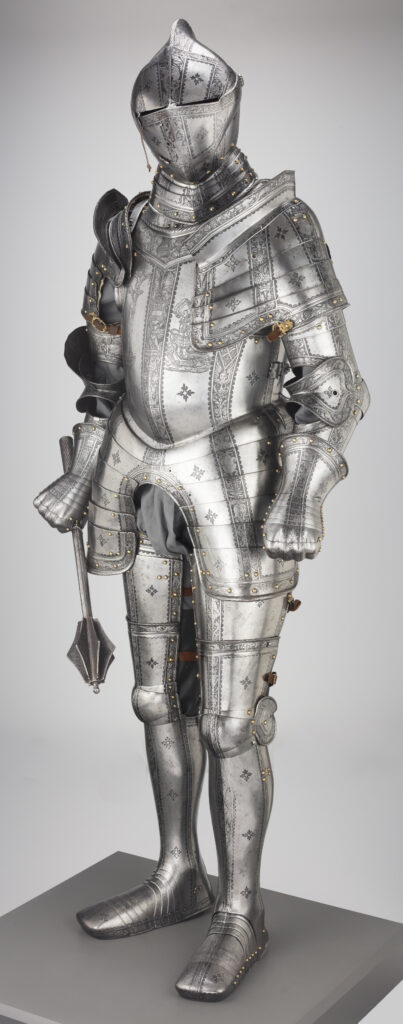
Despite the closing of the Higgins Armory, a sad day for Worcester folks of all ages, this collection has lasted AND it has stayed in Worcester, making guest appearances at other museums and at WAM, all of this time readying for it’s collective debut as a pair of Arms and Armory galleries. Armor of diverse country origins and materials (including metal, leather and even 400 year old silk), has been preserved and polished, the collection has been merged with modern design elements, interactive displays and a local intentionality. This is not the MET, this is not Boston, this is Worcester at its finest: resilent, glorious, multi-cultural and proud. On November 13, 2025, WAM wowed What’s Up Worcester at their media preview of the long-awaited unveiling of the renovated Arms and Armor Galleries. The Galleries are poised to open in their Neo-Medieval glory to the public today, November 22! The 5000 sq foot space is in some ways a reimagining of the beloved Higgins Armory Museum, of local lore, but with the rust shaken off. The steel and glass building at 100 Barber Ave housed the knightly metal collection from 1931-2013. (You know you’re from Massachusetts if you are an adult who went on an annual school trip to Higgins Armory!) But since art and money are always connected, the original $17000 endowment could not sustain the upkeep of such an extensive and rare (outside of Europe) collection. Luckily WAM led the charge to acquire and preserve John W. Higgins extensive collection in 2014, said Matthias Wascheck, Jean and Myles McDonough Director, The arms and armor’s former home, the Higgins Armory building, is now a popular wedding venue.
No damsels nor knights need be distressed. The mostly 14th-16th century collection has been in good hands. With the move of the metal went Jeffrey L. Forgeng, the enthusiastic and brilliant Curator of Arms & Armor and Medieval Art, who has engaged with the collection since 1999. One might say he knows every nut and bolt about the collection. Jeff is fueled by his life-long love of art to “bring up a generation of museum goers,” he said in the reception remarks. His knowledge of arms and armor and Medieval art is unparalleled, and he is great person to know of you love history!
It is hard to out-do the Higgins Armory, with its vaulted ceilings and hidey-hole spaces for kiddos, but that is not the goal at WAM. Matthias Waschek, said, “The museum is transforming…it is a historic moment that we are opening these galleries, but it is one of many historic moments.” The goal is modernize and create a space for local imagination, creation and community spirit without losing the unique feeling of museum visit. Again, not to worry!

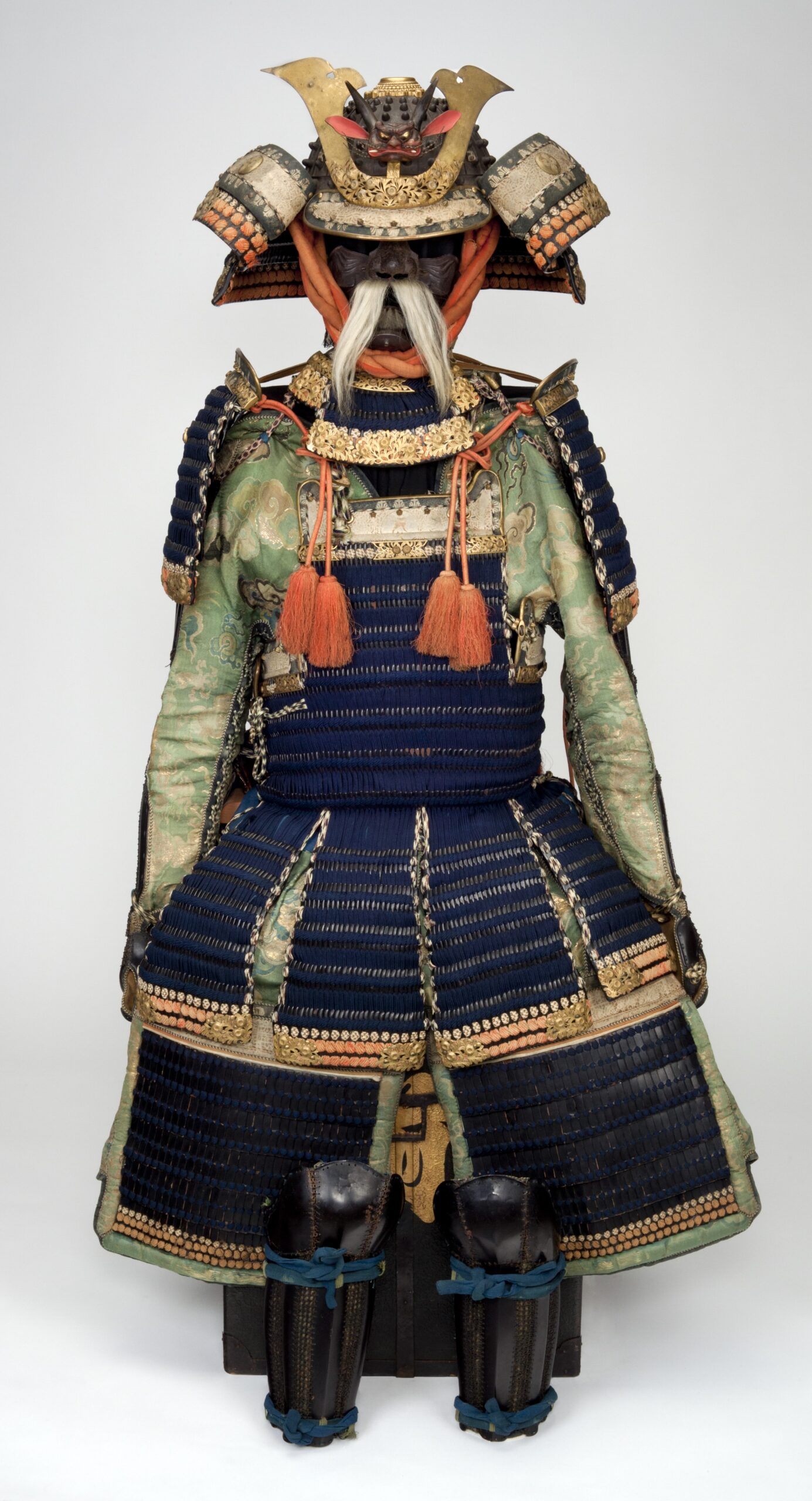
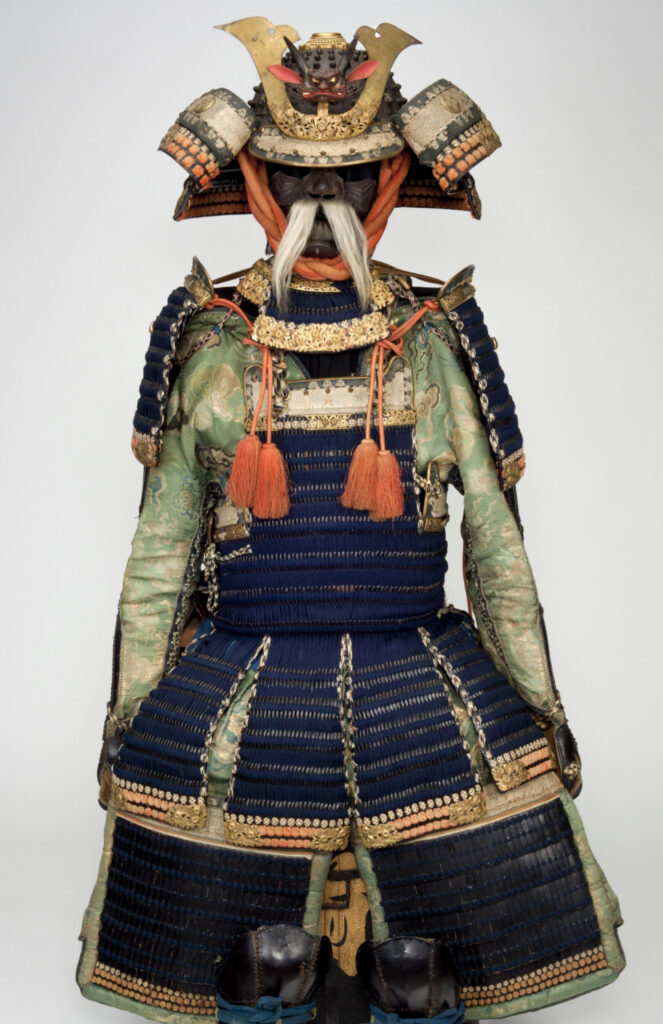
These galleries are magical and awe-inspiring in a more nuanced and deliberate way. Gone are the Corinthian columns, dark rust-provoking corners, and in-your-face knights on horseback. Medieval merges seamlessly with Modern using simple lighting, familiar shapes and and 360 views of the objects. The art represents the height of medieval technology in warfare and metallurgy from around 1550-1650 AD in Europe, with some rare pieces forged in the 1400s in India and others up to about 1850 in Africa. There is even a full Samurai The diversity of the collection is a prominent feature of the gallery. Two goals during the genesis of these galleries were: diversity and local appeal. WAM has de-centralized the European view and allowed for greater cultural dialogue, including a large colorful wall mural inspired by Asian arms and armor.
Upon entering the gallery, the light installation by IKD looks like modern chainmail arched and wrapping light around a 360 view of the three central knights representating African, Asian and European. IKD, a brilliant design firm from Boston, worked in collaboration with Dr. Claire C. Whitner, Director of Curatorial Affairs and the James A. Welu Curator of European Art, and the rest of the staff to create a space that is not only eye-pleasing, but is inspiring and interactive and splices through the Euro-centric narrative.
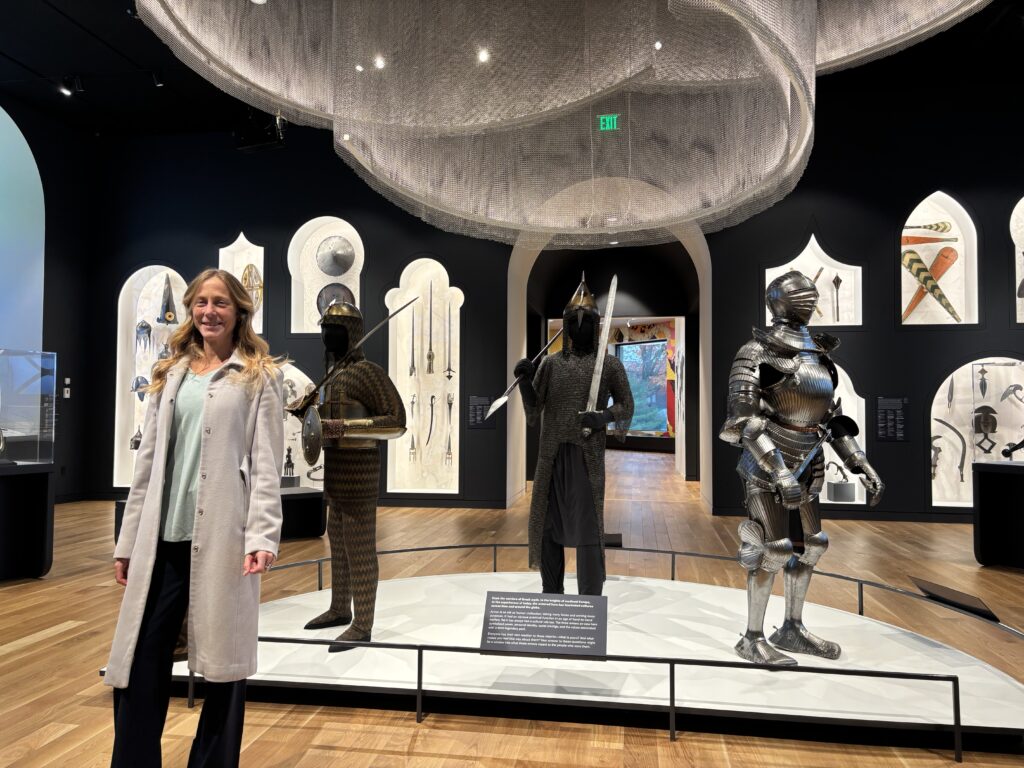
After opening remarks by Matthius Waschek, Jeff Forgeng led the media on an extensive tour and Q&A of the remarkable galleries. The galleries themselves house over 1000 pieces and serve also a prototype for an “open storage concept.” This means viewers are truly behind the scenes in art preservation and curation practices, and in fact, the team at WAM hopes to engage students, artists and groups as “guest curators” within the space.
Keepers of the art
Museum curators are sentries, scholars and interpreters of art. They manage, organize, acquire and present collections from antiquity to present that require special knowledge of materials and preservation methods. This is no task to be taken lightly; these pieces of history can be fragile and also priceless. The recent Louvre art heist resulted in the theft of 8 objects worth an estimated $100 Million. Guest curators will be able to learn how to handle the artifacts and organize them to make a meaningful themed interpretations.
Jeffrey Forgeng said the message WAM wants visitors to have in the galleries is:
“I belong here. This is a place that will welcome me”
Jeffrey Forgeng, CUrator
The Arts and Armor Galleries and WAM are changing with the times to be a community creation fueled by the excitement of “the old” merging with new perspectives and diversity-forward exhibitions.
Many More Reasons to Visit WAM
Art is, and must be accessible– If you live in Worcester, WAM is in your backyard, It is your playground. You can meet your neighbors there, and extreme care is given to accessibility of art and history to all people of all cultures, neighborhoods and and economic circumstances at WAM, Kids under 17 are free. People with SNAP, Connectorcare, WIC and other programs can use a checkout code for free admission.
WAM wants everyone to come and enjoy the space, not just the arms, but the classes (carefully designed by Marnie Weir, Director of Learning and Engagement), interactive exhibits, and 3000 years of art that encourage dialogue, particularly about diversity and alternative narratives. Everyone can identify with something, if only one thing, at WAM. Elevators and and quiet spaces, broad pathways through the displays and integrated seating allow people of all ages and abilities to enjoy the museum. This is especially true in the newly installed Arms and Armory galleries. And who doesn’t love a knight in shining armoir, a hero prototype or a really cool sword?
Art is an experience– Museum art offers an opportunity to connect with our own history and understand others; without words, without arguments, and without the noise of the world outside the door. Wam’s arms exhibit is specifically meant to be interactive and allow all ages to feel at home. We are invited to find our space within the museum by locating what speaks to us. One piece of art or one exhibit can elicit emotion and connection.
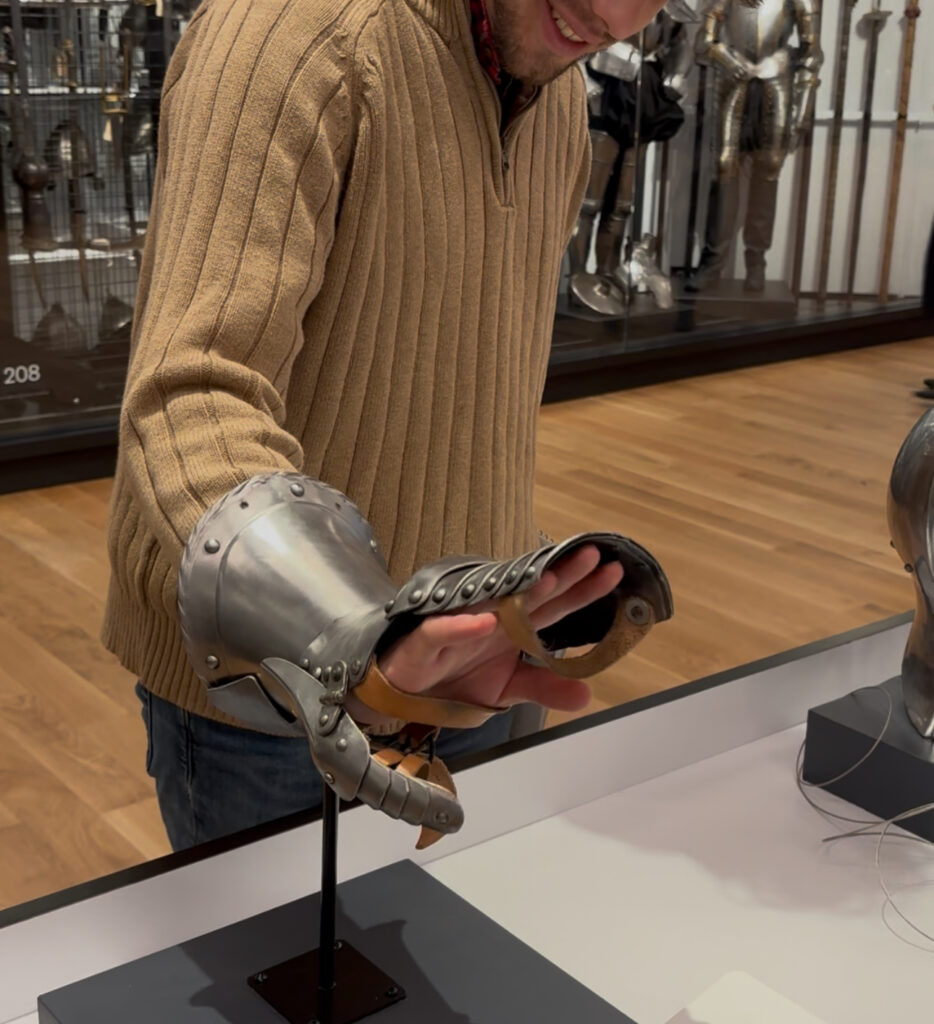
Art informs culture and reports on culture (much like the news!) Art, like reading or doom scrolling, allows the imagination to wander and journey where the body perhaps cannot go. It allows us to dream and to remember. It inspires. Art is a journey through time, and hands on components of this installation allow visitors to try on a helmet or gauntlet (metal glove) and see how a knight might feel. One can test the weight of a sword and use ipads and interactives to learn more about each suit, standard or weapon. Vistors will learn how armament was trending fashion in the 1550’s!
An exceptional and creative component of this exhibit is that it doubles as the actual storage, preservation and curatorial space for the immense collection. In other words, visitors are behind the scenes of caring for a precious collection, and much of the design space mimics either how one might display the pieces in their home or government building or in modular storage racks
Art tells a story– Every piece of armor has a story, of the man who wore it and the one who crafted it. It speaks about the era in which it was used and the time it was abandoned for other technology. Somehow each piece found its way to Wam, from someone’s family or a collector’s spoils, from another museum or even from someone’s attic.
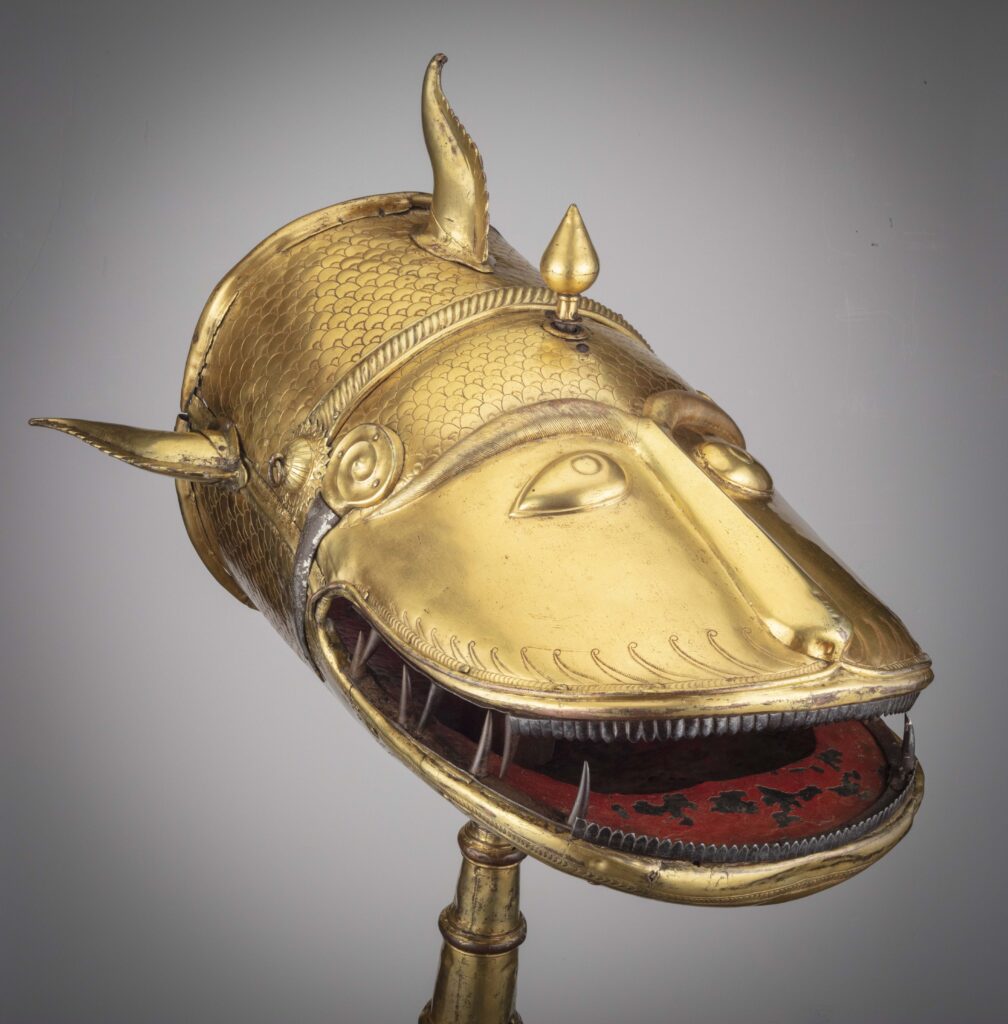
All armor has made the journey through time from as early as the 1400s (India) and as late as 1850 (Africa). Someone preserved it or found it and revived it. Most of the armor is from Europe, but WAM has some beautiful pieces from Japan and Egypt, for example, and hopes to acquire more diverse armor. The materials vary from location and time period. All of the pieces allow you to imagine who wore it or used it and how that technology operated in their lives. Did it separate the elite from the poor? Who toiled over a sheet of hot steel and carefully shaped it? Who cleaned it and polished it after a battle? Did extensive armories show national or family pride or flaunt wealth? For example, Henry VIII’s stunning arsenal crafted by Italian artisans and painted by Titian is visual proof of a rich man’s toys (not unlike Lambourghinis and private jets).
Art sheds light on technological advances: Worcester knows innovation with seven colleges including Worcester Polytechnic Institute, UMASS Chan and dozens of industries. In fact, the first fuel-powered rocket was born here and lanched in Auburn by Robbert Goddard. Armament was technology and fashion of its day. Trends in armor reflected status were important precursers to modern war technology. Armor could be easily individualized and diversified reflecting progress and indivual taste. It can be can view it like this:
A simple iron helmet is a Blackberry. It gets picked up by another nation and evolves into a flip phone (the helmet is now fortified with steel). It presents challenges and looks bulky, so it is adapted to an Iphone (The helmet now a face shield). This new Iphone can be personalized and “beautified”. (the helmet is now embellished with the owner’s family crest). Every iteration of a metal helmet becomes more appropriate for the individual and type of combat, just as every generation of Iphone has new bells and whistles, looks sleeker, operates more quickly and is more user friendly (hopefully).
Worcester is an industrial city, rooted in: pride of craftsmanship; cultural plurism; innovation and community. The Higgins Arms and Armor collection has traveled with specialized couriers who know how to pack and unpack, curators who know how to arrange and display it and lots of love for art. It was stored below the museum in special climate controlled space for a decade and has and been reborn in its entirety. This is the beautiful, thoughtfully crafted Arms and Armor Galleries Exhibit at Worcester Art Museum. WAM got it right with a new and exciting Worcester resilience story. You must visit: You belong here!
Betsey Taft Kennedy, Managing Editor, What’s Up Worcester, betsey@whatsupworcester.com
What’s Up Worcester thanks WAM for the early access, for their reponsiveness to questions and for their community-first values. A special thanks to Madeline Feller, Director of Communications and Marketing, for reaching out to us.
About The Author




Comments are closed.
[…] creative, yet still locally authentic, directions. A recent example is Worcester Art Museum’s Arts and Armor Galleries. The design is intended to present a uniquely Worcester local experience, which draws folks to our […]
What’s up, gamers?! Gameiwin’s been my go-to lately. Quick payouts and lots of variety. Give it a go!: gameiwin
Heya i am for the first time here. I found this board and I to find It truly helpful & it helped me out much. I hope to offer one thing back and help others such as you helped me.