What’s Up Worcester got an insider view of a local artist’s studio, and it is our honor to present “Art by Abu,” communicator of Joy.

75 Webster Street- Tanzanian born artist Abu Mwenye creates modern African art from the heart and from his own memories. He has brought Africa to Worcester in the vivid colors of his subjects: people, animals and instruments native to Africa. Mwenye’s art is meant to communicate joy. It is impossible to be in his (or his art’s presence) without feeling a deep sense of joy and gratitude. WUW even bumped into him supporting fellow artists at the Juniper Rag Delirium opening at JMAC.
Worcester residents may already be familiar with his vibrant yellow WooBox outside the courthouse or his studio, which in tandem with 3 other local artists, is open for visitors and art buyers every second Saturday of the month from 12-6 at 75 Webster Street. This month they are open to conversation and tours on Saturday, November 8. Mwenye’s studio sitting in one of Worcester’s hidden gem industrial rehab buildings is apropos to his enthusiasm for community, joy, people and history.
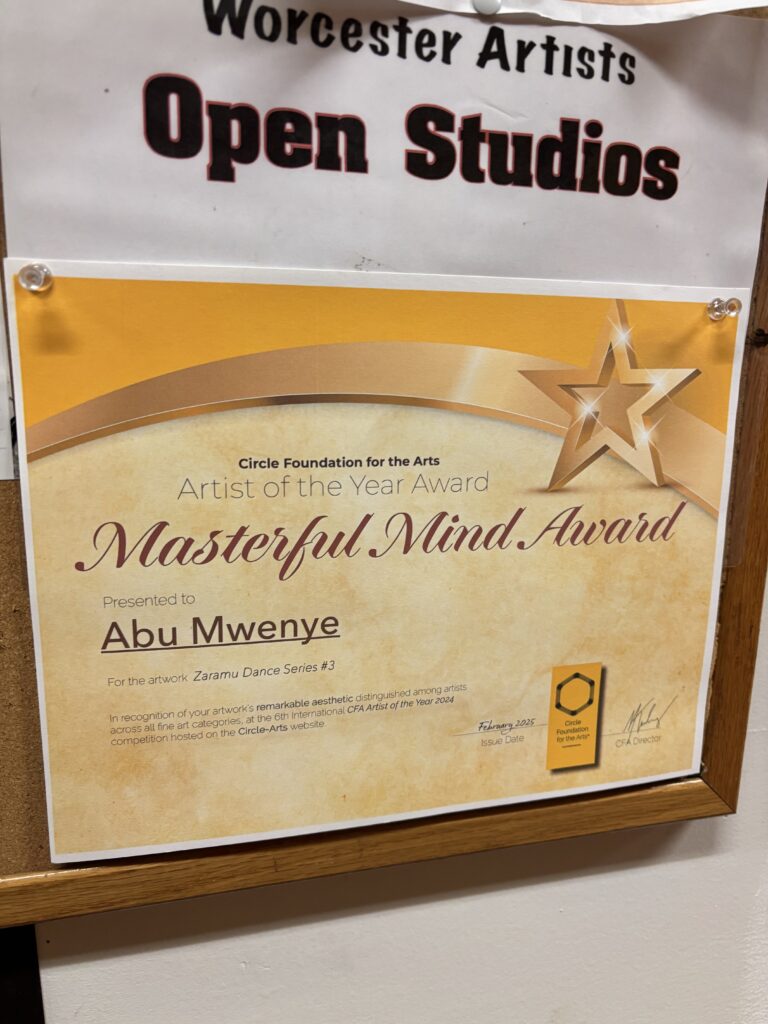
With no classical art training, he draws inspiration from his childhood in Tanzania and Kenya and says he can’t explain how his talent grew. It just “flows” onto the canvas, he sats. Yet it is in no way raw. The way he plays with shapes, shadow, and color creates movement that draws one into conversation with each piece and with him. He loves to hear interpretations of the work with which he has communed during it’s inception and says; “there is pain in when selling a piece” because it has become part of him. Though Mwenye uses familiar colors and themes of African art, he puts a deeply personal spin on his work. The sense of joy and connection in each piece is palpable. Mwenye is humanity. He is community.
Mwenye’s kind spirit and energy can be felt in his art, his vibrant studio and in who he is. He is a trained CNA and has volunteered with the African Community Education (ACE) program which “empower[s] African refugee and immigrant youth through educational, leadership, and cultural programming.” He even designed their logo!
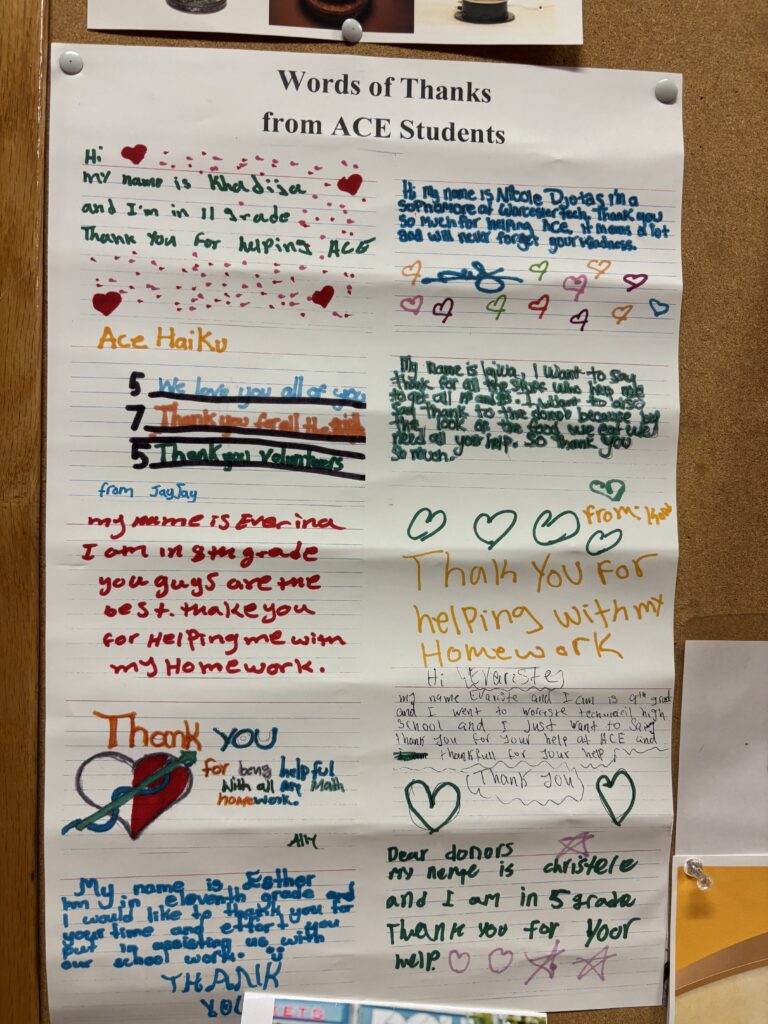
Mwenye grew up in Dar es Salaam and was often teased for drawing cartoons in class. He says art was a fun hobby and not a career path in Africa when he was a child, though he did win an art award in grammar school. He says “it was different in Africa than America. Here [USA] people appreciate art.” He says in Tanzania, he wasn’t aware of families adorning their walls with fine art, though family portraits were common. His mother supported his move to college in Nairobi for graphic design, and he was also trained in mechanics with the encouragement of his father who was a vet tech. He is one handy man to know!
When Mwenye came to America as a young man to be near his mother, he trained to be a CNA (because in America the “starving artist” is not mythology.) Something very interesting about Mwenye is his commitment to athleticism and caring for his health. He says his daily morning workouts start his creative engine. His drive and laser focus on: his art, caring for his clients and contributing to the community obliterates the trope of the reclusive, tortured, self-medicating artist. He is as vibrant and communicative as his colorful creations. He makes African art accessible to everyone. It is his joy pouring from his heart onto canvas.
Exercise energizes my creativity
Mwenye
Mwenye says he commits images to memory, which can be seen in his early work featuring African villagers. This series of portraits looks like photographs from National Geograpic magazine in the 1980s, and in fact, it kind of is. These remembered images are his childhood in Africa. While we in America watched the hunger and AIDS crises on TV, Mwenye observed and recorded humanity in real time. He saw Masaai and Samburu people when he traveled across the Tanzanian/Kenyan border each summer to visit family. He also said the tribal peoples used to be seen in the cities doing business, but less so now. (A story for another article perhaps?)
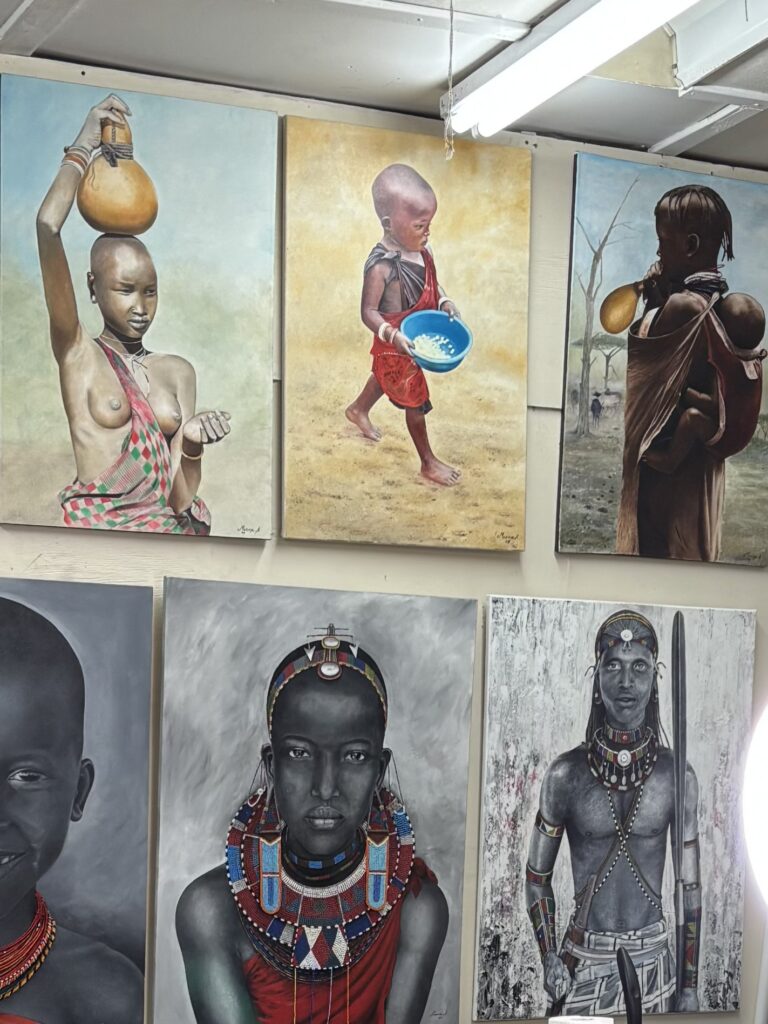
His study of faces, as evidenced by his ultra-detailed black and white portraits, cannot be accidental. Mwenye truly connects and sees at the same time. He says he visualizes his acrylic paintings in his head. He does occasionally study photographs to ensure his subjects are authentic, such as this Masaai man pictured below.

But Mwenye doesn’t stop at painted portraiture or classic figurative imagery of Masaai tribal women, though he does it so well…
He has been leveling up to 3D imagery adding structural elements such as beads and painted styrofoam that make his images even more alive. His current series Beauty in the Beads features dramatic black and white portraits with colorful raised beading. One has to see it to believe it is not AI: It is not! What’s Up Worcester can verify authenticity, as well as the amount of time, energy and supplies Mwenye puts into these works. They are a must-see whether at his Open studio hours, by appointment or at SOWA in Boston where he has an additional studio.
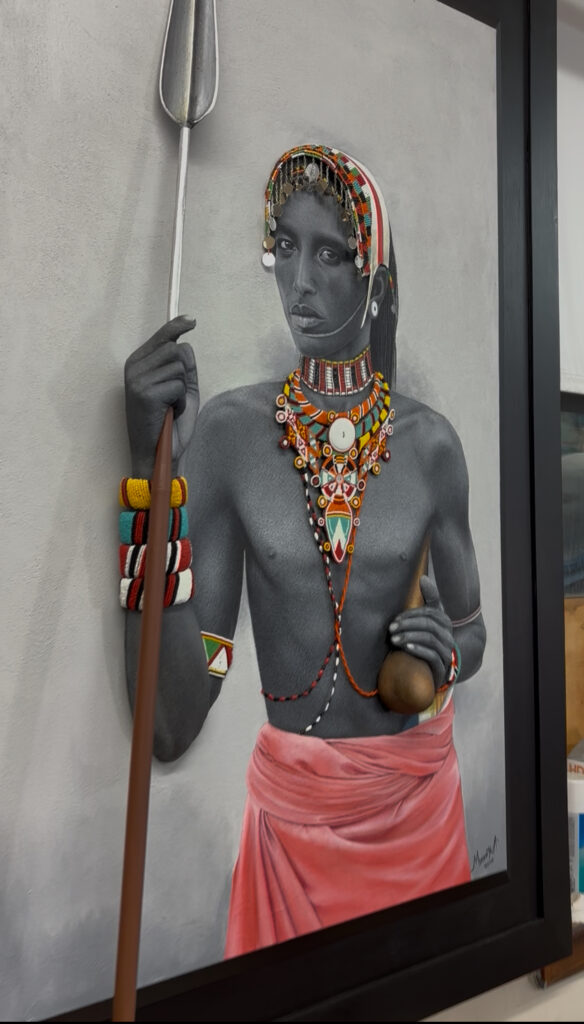
This is NOT AI
This series is so captivating our writers cannot find adequate words! And there is more.
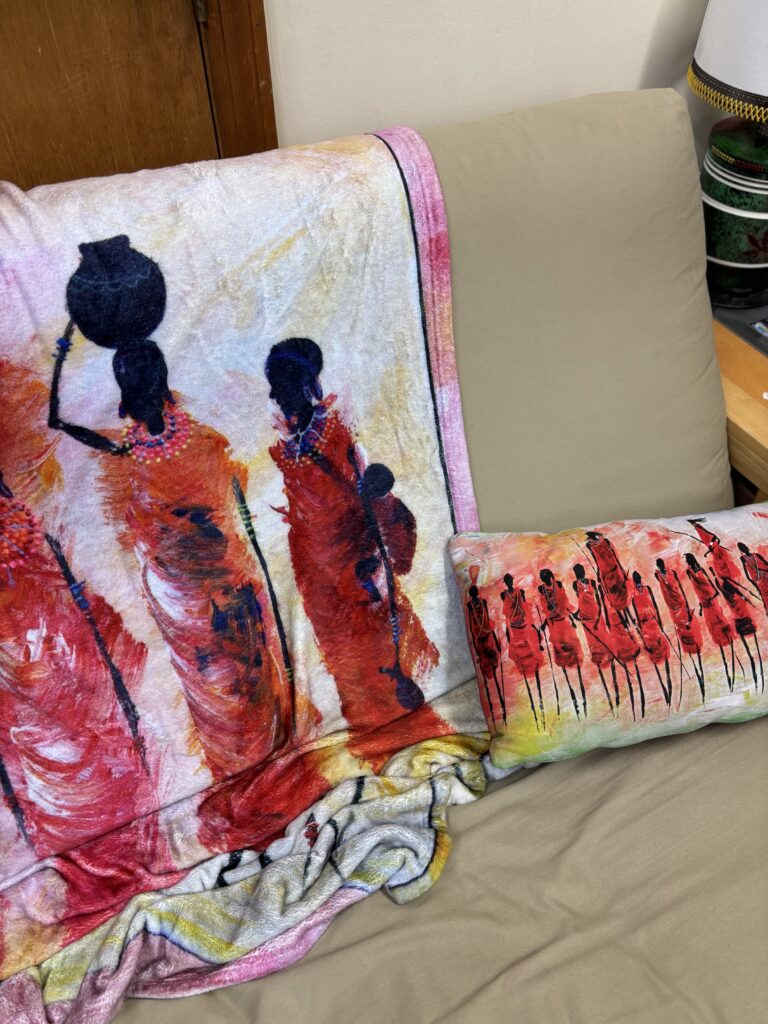
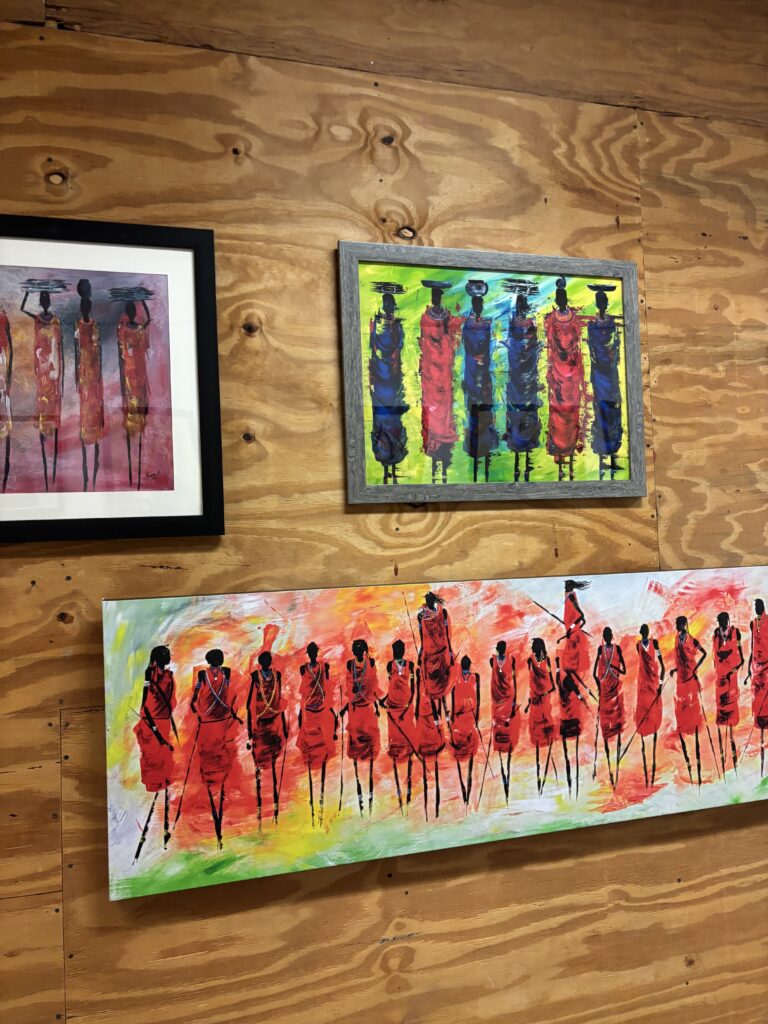
Mwenye’s abstract series, heavily influenced by African instruments in bold lines and curves, feels like New Orleans Mardi Gras. The clean arcs of the dancing figures and geometric shapes of the instruments could be likened to the Kokopelli (look at the sketch he drew for WUW!)  but the colors and tribal pattern sing of African roots. Mwenye says this image is joy and music, people smiling in communion with each other and the audience. What’s Up Worcester believes him because we felt it.

He is open to lively conversation about his art and to different interpretations. He knows that American eyes may see differently than African eyes and he embraces such. Mwenye says his art is for people to find meaning and joy.
A visit to Abu Mwenye’s studio is a break from the chaos and anger in the world today. An Art by Abu original would elevate any home!
Betsey Taft Kennedy, Managing Editor, What’s Up Worceseter, betsey@whatsupworcester.com
About The Author