What’s Up Worcesester asks: Are La Catrina iconography and Day of the Dead festivals in the US Cultural Appropriation of a Mexican Tradition honoring the deceased?
Everyone knows Coco, the colorful animated 2017 Disney film, in which aspiring musician Miguel, confronted with his family’s ancestral ban on music, enters the Land of the Dead to find his great-great-grandfather, a legendary singer. The unmistakably latin-inspired soundtrack caught on in mainstream sound clouds .

 1 A similar film was released in 2014.The Book of Life follows Manolo Sánchez, who, alongside his friends María and Joaquín, embarks on a journey through the Land of the Remembered and Land of the Forgotten, guided by the gods La Muerte and Xibalba. These films introduced the masses to the colorful imagery, dancing carinas, sugar skulls and altars (ofrendas) symbolic of the Mexican holiday Dia de los Muertos (Day of the Dead).
Dia de los Muertos is not Halloween
Today, it is common to see little Carinas trick-or-treating, and Target has capitalized on the vibrant and iconic symbols of the holiday. Day of the Dead calvera (sugar skull) makeup tutorials flood Youtube and Tik Tok. (See a tutorial here.)Though it is unsurprising to see the iconic carina look on Halloween (October 31) here in America, one wonders if this cultural appropriation dishonors the Mexican holiday which actually falls on November 1 and 2 and has an entirely different meaning.
Alas, Halloween is technically one day early for the appearances of Catrina and Catrin (catrin meaning a well-dressed person). Additionally, Dia de los Muertos is most deeply rooted in Mexican culture, where families honor deceased loved ones and spend time in communion with living relatives. It is a time when the line between life and death thins and deceased loved ones are welcome to visit the living in the form of benevolent spirits. It is a joyful, if bittersweet, celebration that bears no resemblance to the creepiness or candy of Halloween. (Read about the history of Halloween here).
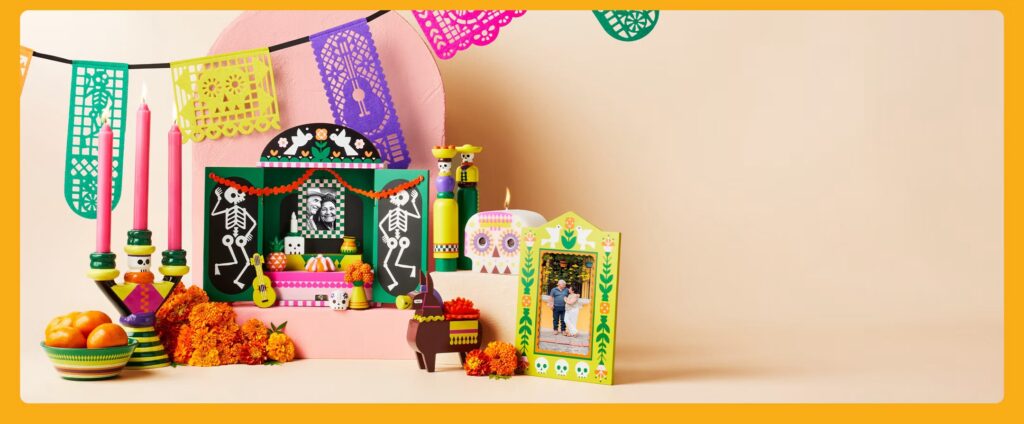
Families traditionally celebrate Dia de los muertos by building ofrendas (altars) including photographs of their deceased loved ones with offerings of food and drinks favored while alive. The tableau can include: marigolds (cempashuchil) to guide spirits, candles to light the path, sugar skulls (calavras), spices and incense. Importance is placed on personalization of this welcoming family space for ancestors and deceased loved ones to be in communion with the living. Public celebration has become standard in Mexico and now in America.
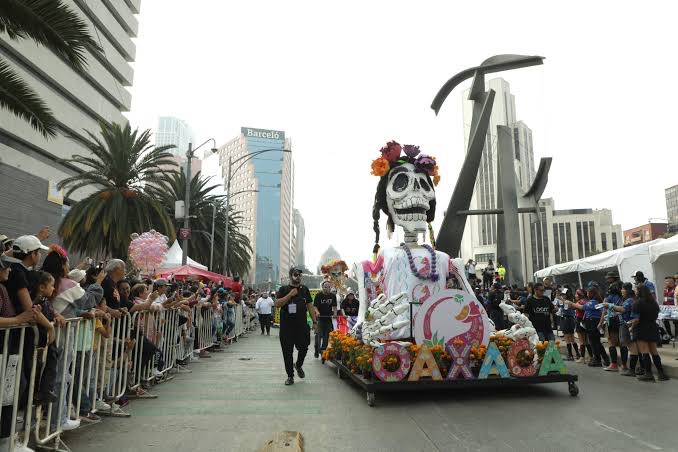
Dia de los Muertos is a celebratory time in Mexico, with cities and towns holding week-long festivities and colorful parades culminating and ending on November 2. A key element is building larger than life Carina sculptures, floats and decorations. Mexico City, with a population of 22.8 million people, is the epicenter of the holiday action for obvious reasons.
The tradition has carried over to Mexican-American populations in the US, with San Antonio, Texas (view link) boasting the largest Catrin and Catrina in the US and many cities hosting large processions of costumed dancers, inviting the public to don their colorful dresses and calvera makeup and join the fun. But who is la Catrina? How did the “elegant skeleton” go viral?
The history of Day of the Dead and the iconic la Catrina are rooted in Mexican history.
The roots of Dia de los Muertos and of la Catrina are dark and tied to Mexican families retaining their ancestry and culture during and after the scourge of colonialization and then dictatorship. They are tied to freedom from oppression. Mexico was once filled with ancient village complexes and inter-tribal trade networks, most famously the Aztec and Mayan. When the Spanish arrived in the 16th century, they depleted, abused and displaced indigenous Mexicans and disrupted tribal roots. Europeans reinforced Catholicism in Meso-America with observances of All Saints’ Day and All Souls’ Day (November 1 and 2) which, over time, merged with existing Indigenous practices, creating the modern Día de los Muertos. Many historians say la catrina can be seen as a modern take on the Aztec queen of the underworld, Mictēcacihuātl, who presided over ancient death rites. Some liken her to Coatlicue, the Aztec earth mother who is associated with fertility and the duality of birth and death, often represented in Aztec art with a skull (calavara).
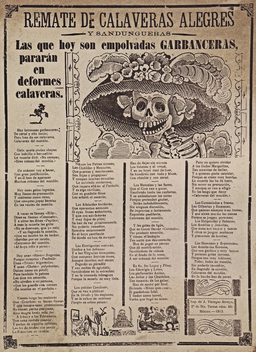
The original la Catrina, as we know her, appeared in the early 1900s as a political cartoon2 drawn and proliferated in volantes (flyers) by artist Jose Guadalupe Posada. Not yet formally connected with Day of the Dead celebrations, she was a skeleton head (calavara) with a French hat representing Mexican imitation or appropriation of European culture brought by colonizers, most specifically a commentary on politicians and members of high society. According to this article in the The Mazlatan Post, her original name was La Calavera Garbancera, a satire of “garbanceras…often indigenous peasants, who sold garbanzo beans and, in the eyes of the creator, tried to hide their roots by imitating European styles of dress and rejecting their Mexican heritage.” Posada was essentially pointing a skeletal finger at the vanity and greed of longest-ruling Mexican leader Porfirio Diaz, whose corruption ultimately led to the Mexican Revolution of 1911, through volantes meant to educate the common working class.
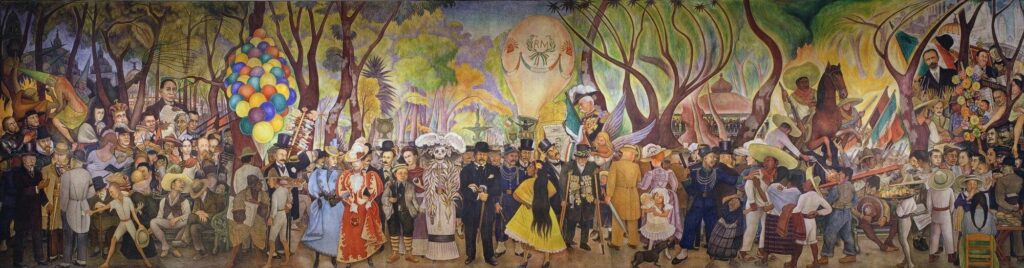
After the Mexican revolution, la Catrina appeared again in an influential painting by famed Mexican artist Diego Rivera called Sueño de una Tarde Dominical en la Alameda Central (Dream of a Sunday Afternoon at Alameda Central Park). Rivera claimed Posada as a mentor and artistic luminary. In this painting, la catrina appears in full body wearing European clothing, yet she can be seen as standing for a lost Mexican ancestral story coming back to the people in the form of the Aztec mother earth goddess Coatlicue (or alternately seen as Michtecacihuatl.) Different interpretations aside, the piece clearly reflects 400 years of Mexican history, and la Catrina is the central figure.
Mexico fought long and hard against colonialism and for independence from corrupt rulers. In reclaiming Mexican national spirit, “the elegant skeleton” became intertwined with Dia de los Muertos, joyfully welcoming the stories and people of Mexico’s past into their rightful homes. In more recent years, makeup trends for celebrating Day of the Dead playing on la catrina and calvaras incorporate the colors and flowers traditionally part of altars (unlike the stark colors of Rivera’s depiction). Thus it can be seen that over decades, la carina has evolved by adding layers of duality in the complex social and political history of Mexico, and she will liekly continue to take on meaning in years to come (as evidenced by the popularity of Coco and the Book Of Life in this past decade).
In this article on HipLatina.com, writer Jennifer Vasquez says, “La Catrina is significant to many people and bridges the past to the present. She keeps Mesoamerican traditions alive, reminding us of where we come from and where we will return”
Where are people celebrating?
 Worcester: Ofrendas are on view to the public at the Worcester Public Library curtesy of Casita Cultura Latina, who state on their website that their annual Día de los Muertos in the Woo has been reimagined for 2025 “to meet the moment our community faces with care, respect and pride in our cultural heritage”.
Boston: BSO Celebrating Dia de los Muertos: A Tribute to El Divo de Juárez. Boston Symphony orchestra performs at Symphony Hall in Beantown today.
For more information about la Catrina and her significance see below.
Betsey Taft Kennedy, Managing Editor, What’s Up Worcester, betsey@whatsupworcester.com
*Ethical Note: Feedback and correction always welcome. This writer is not Mexican and does not claim latina roots, but attempted to make a fair representation of research. What’s Up Worcester is committed to supporting cultural diversity and telling stories that resonate with our city.

We want to hear from our readers.
We would like to make a call for local stories, artwork, writers and conversations. Please reach out!
About The Author